
If you have ever watched a toddler spend twenty-five uninterrupted minutes transferring water from one plastic cup to another, you have witnessed something incredible. To the untrained eye, it looks like a simple way to pass the time (and make a bit of a soggy mess). But to those of us who spend our days guiding early childhood development, that spilled water is actually a tiny laboratory.
Every splash is a lesson in gravity, volume, and hand-eye coordination. This is the magic of early childhood education – it happens when we stop separating “playing” from “learning.” When families search for high-quality Jackson Towne daycare programs, they often ask us how we balance academic preparation with playtime. The beautiful truth is that you do not have to choose between them.
Let’s explore how intentional, play-based learning transforms everyday moments into profound developmental milestones and what to look for when evaluating early childhood environments.
You may have heard “play-based learning” tossed around and wondered whether it’s just a fancy phrase for free time. That’s a fair question, and it deserves a straight answer.
Play-based learning is not an unsupervised free-for-all. It’s carefully designed. Young brains develop at an astonishing pace, and children simply aren’t built to sit quietly memorizing flashcards. They learn with their hands, their feet, their voices, and their senses.
When a child plays with intention behind the scenes, they’re building skills that stick:
The difference always comes down to intention. Every activity in our rooms has a purpose, even when it looks like your child is simply playing.

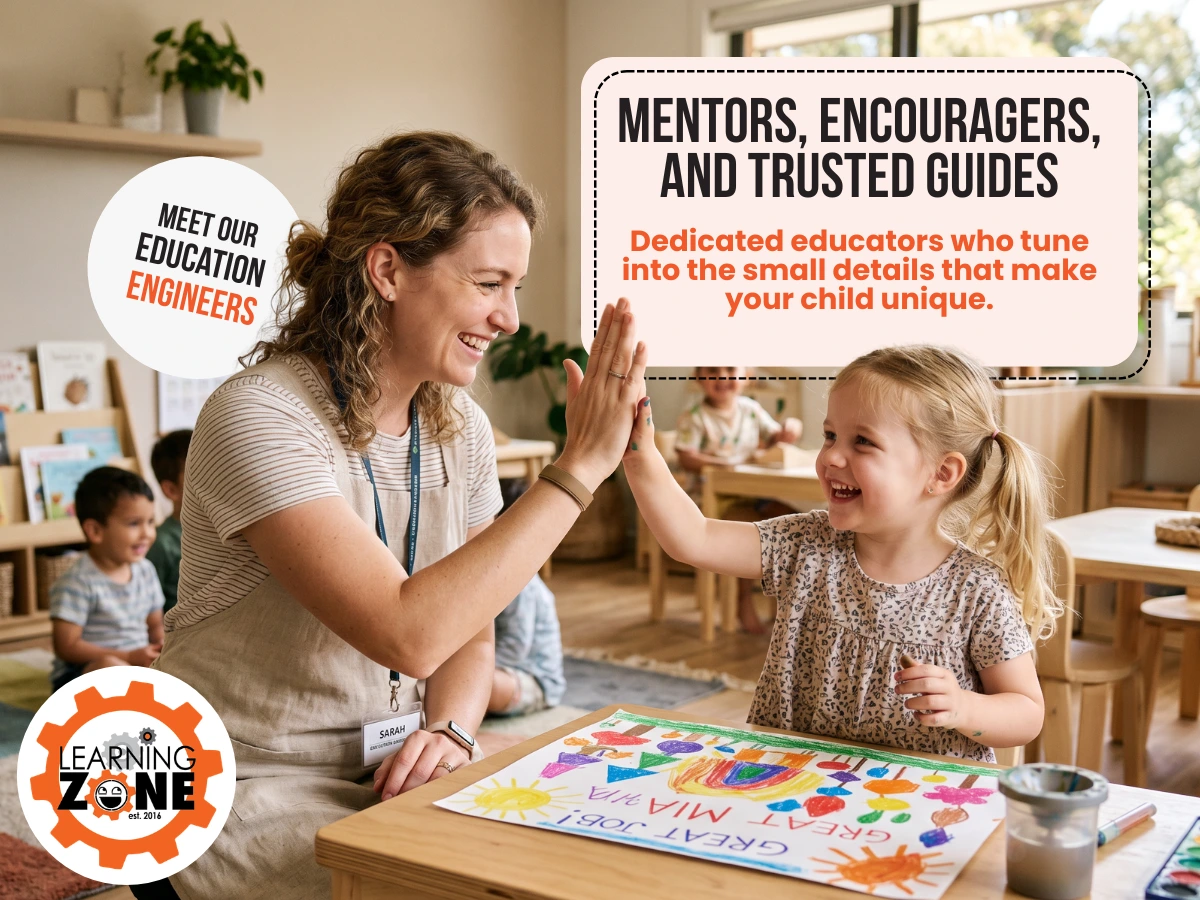
We don’t call our teachers “staff” or “monitors.” We call them Education Engineers, and the name is deliberate.
An engineer designs and builds with purpose. That’s exactly what our teachers do every day. They construct rich learning environments, then step back and let discovery happen. They know when to let a child wrestle with a puzzle, and when to lean in with a gentle question that sparks an “Aha!” moment.
If a group of kids is obsessed with building a train track, an Education Engineer won’t just watch. They might ask, “What happens if we run the track over this bumpy rug?” Suddenly a simple game becomes a lesson in balance and problem-solving. And because they keep our group ratios small, your child is never lost in the crowd.
At the heart of our Jackson Towne Daycare Program is our exclusive C3 Curriculum. The three C’s stand for Curiosity, Creativity, and Comprehension, and together they shape everything we do.
Here’s what makes C3 special: it’s flexible and theme-based, which means it meets your child exactly where they are. Not every child learns the same way, and that’s completely normal.
If your child learns differently or isn’t at the same stage as their peers, C3 has room for that. No child gets left behind, and no child gets held back.
Science, Technology, Engineering, Arts, and Math might sound like heavy topics for little ones. But STEAM shows up naturally in the way children already explore.
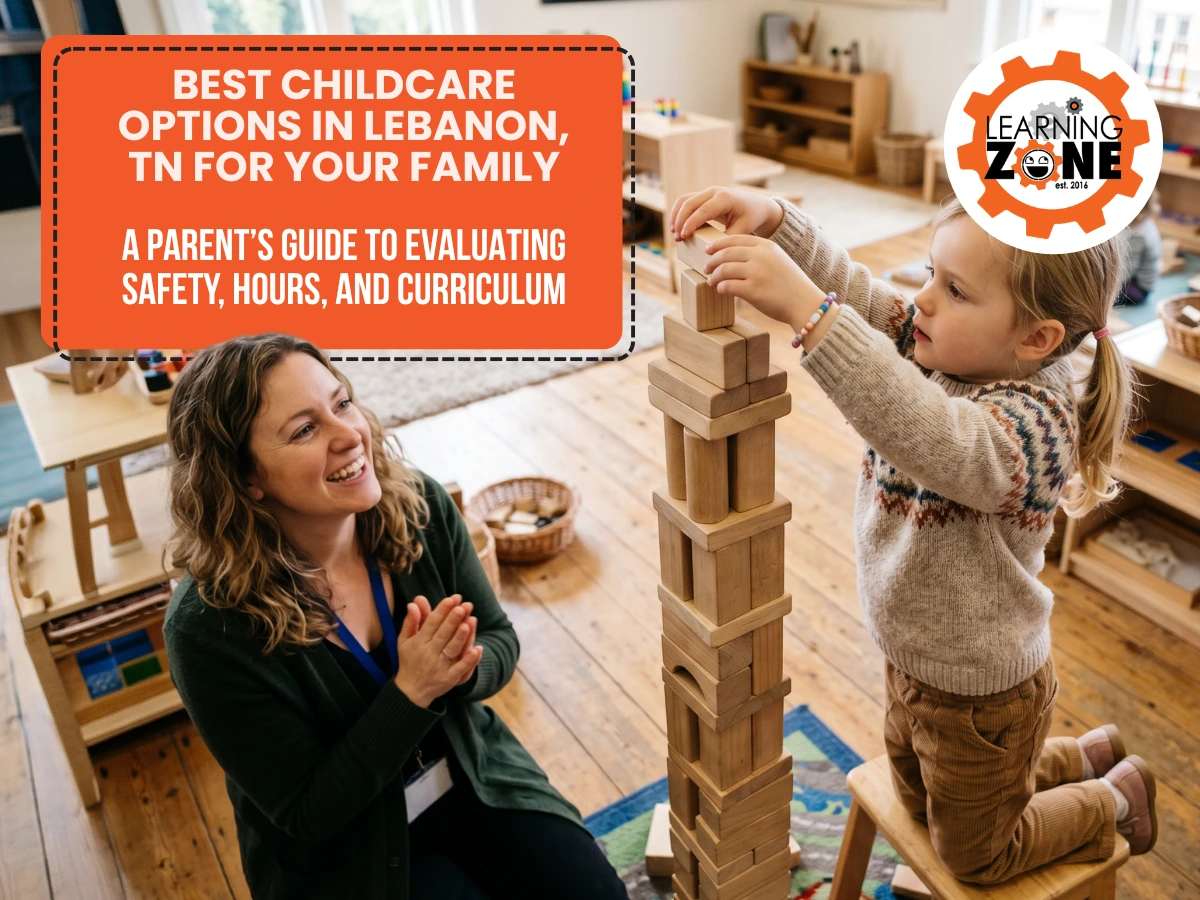
When your child stacks blocks and tests how high the tower can go, that’s engineering. When they mix colors during art, that’s science. When they count snack pieces or spot patterns on the carpet, that’s math. Our Education Engineers simply guide those instincts into real, foundational skills.
This is where we bridge a common gap. Many corporate franchises lean on rigid worksheets, while others offer little more than basic supervision. We combine high-level STEAM concepts with a cozy, family-first environment, so your child gets the best of both worlds.
Food is one of the best teachers around, and our Seed to Table program proves it. This isn’t an occasional extra. It’s a core pillar of our monthly curriculum, directly connected to our C3 and STEAM approach.
In our outdoor Grow Zones, children get their hands dirty in the best possible way. They touch soil, smell fresh herbs, and watch plants sprout from tiny seeds. Then comes the fun part: taste tests of real food they helped grow. Along the way, they pick up patience, teamwork, and a sense of accomplishment. Not bad for a group of preschoolers with dirt under their fingernails.
Scrolling through search results, it can be hard to tell the difference between a facility that just lets kids play all day and one that uses play as a real teaching tool. When you tour prospective centers, look for these signs:
Parents of toddlers and preschoolers keep asking the same question: “Will my child be ready for kindergarten?” We focus on The Big Three to help make sure the answer is yes.
Kids who build these early tend to walk into their first classroom feeling confident rather than overwhelmed.

Every stage of early childhood deserves its own thoughtful approach, and our programs grow right alongside your child.
As you weigh your toddlers’ daycare options in Jackson and the wider Murfreesboro area, remember that the toddler years are where the magic really begins. This is the age of big emotions and boundless energy, and our environment channels them into meaningful growth.
Handing your child over to someone new is hard. We get it. That’s why trust and safety sit at the center of everything we do.
Our building features secure keypad entry and video monitoring, so you always know your child is in a protected space. Through the Procare app, you receive real-time updates and photos throughout the day. You can see your child laughing, learning, and thriving, even while you’re at work.
We also hold national NECPA Accreditation, a respected mark of quality in early childhood education. And with nearly a decade of serving Middle Tennessee families since 2016, we’ve earned this community’s trust one child at a time.
Learning Zone Jackson Towne is located at 2327 Joe B Jackson Parkway, Murfreesboro, TN 37127. We’re open Monday through Friday, 7:00 am to 6:00 pm, ready to welcome your family. Pictures and words only tell part of the story. The rest you feel the moment you walk through the door.
Unstructured playtime lets children play freely with little adult guidance. Play-based learning at Learning Zone is intentional. Our Education Engineers design the room, select the materials, and quietly guide children toward milestones such as fine motor coordination and pattern recognition, all through activities kids genuinely enjoy.
Children remember far more when they learn through active, hands-on experiences than through passive worksheets. By weaving early math, language, and problem-solving into games and themes, we help kids understand concepts deeply and walk into their first classroom feeling confident.
We welcome infants as young as 6 weeks, support them through dedicated toddler rooms, and guide them all the way up to our structured Pre-K readiness program.
Absolutely. Our facility features secure keypad entry and video monitoring, and the Procare app sends you updates and photos throughout the day, so you can stay connected to your child’s day from anywhere.
Because our C3 and STEAM-based toddler environments focus on small-group interactions and personalized milestones, space in our toddler classrooms fills up quickly. We keep our ratios intentionally small so every child gets the attention they deserve, which means available slots move fast.
Don’t wait for the next big milestone transition. Schedule a tour at Learning Zone Jackson Towne today, come meet our Education Engineers, and discover a place where your child is genuinely known, joyfully challenged, and perfectly prepared for the big adventures ahead.