


If you are making a list of questions to ask during daycare tour visits, here is the first thing to know: you do not need to show up with a clipboard and a perfectly rehearsed script.
Most parents walk into a daycare tour trying to do two things at once. They are gathering information, yes, but they are also quietly asking themselves, Can I picture my child here every day? That is why tours can feel strangely high-stakes, even when everyone is smiling and the walls are covered in finger paintings.
The good news is that you do not need to catch every detail in real time. You just need to know what actually matters. Some of the biggest clues have nothing to do with the brochure. They show up in how a teacher speaks to a child who is melting down, how the room feels during a transition, and whether the person giving the tour answers your questions clearly or dances around them.
A good tour should leave you with more clarity, not more sales language. And while every family’s priorities are a little different, there are some questions and observations that make the whole process a lot easier.
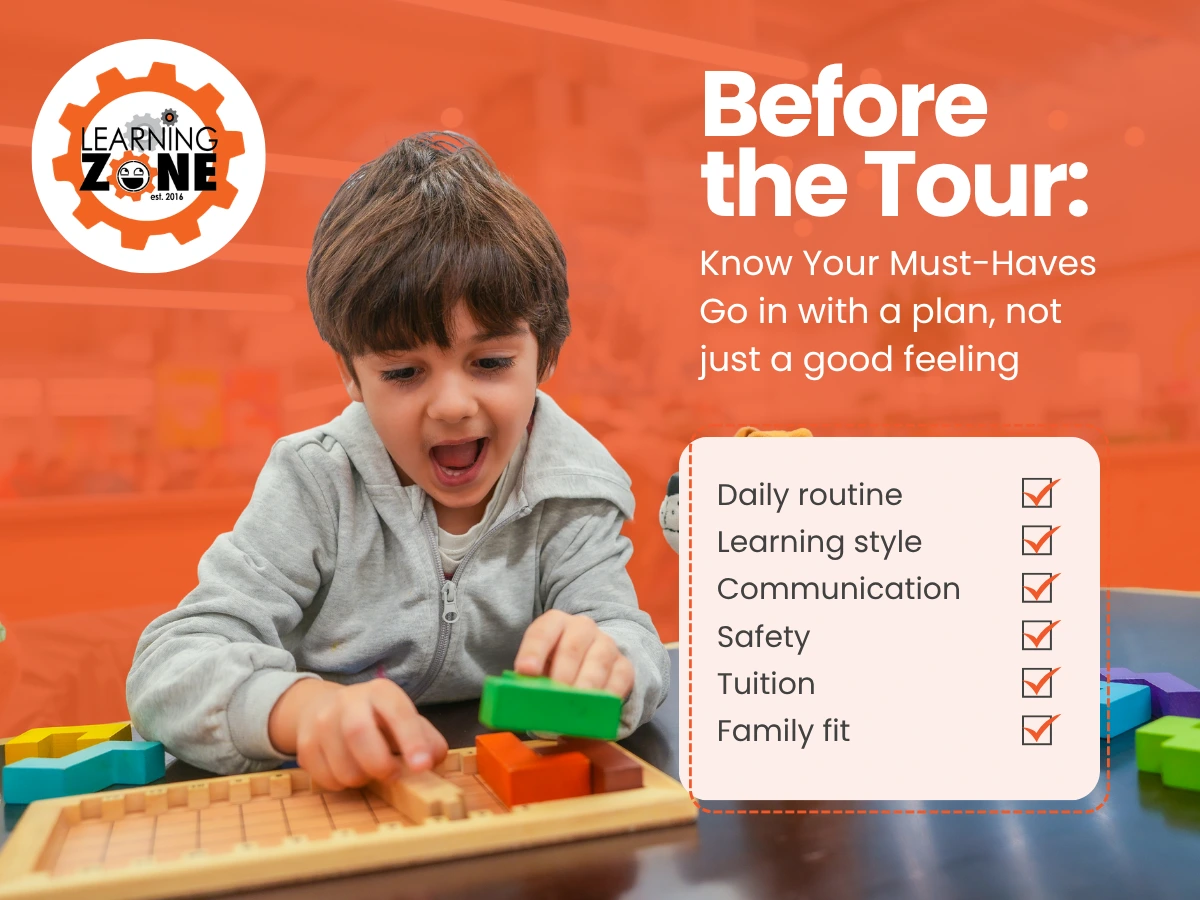
Before you even step foot into a child care center, it helps to get honest with yourself about what you actually care about.
This sounds obvious, but it matters. Tours move fast. You are trying to listen, look around, stay polite, remember your questions, and maybe keep your toddler from licking the window. It is very easy to leave thinking, That seemed nice, without really knowing whether the center checked the boxes that matter most to your family.
That is why a daycare tour checklist for parents should start before the tour itself.
Take five minutes and make a quick list on your phone. Not a giant spreadsheet. Just your non-negotiable must-haves. Not what sounds impressive or what another parent said should matter. What matters to you.
Some children do well with a lot of structure. Some need a little more room to warm up, explore, and move. Most probably need a mix. Think about what kind of day feels right for your child, not just what sounds good in a brochure.
You do not need to be committed to a specific educational philosophy to care about how a center approaches learning. Some parents want play-based care. Some want a stronger academic foundation. Some want both. The point is to know what you hope to hear when you ask about learning.
If your child is heading toward preschool or Pre-K, you may want more than “we do lots of fun activities.” That answer is not wrong, but it is incomplete. You want to know how the center supports language, problem-solving, independence, and the skills children build before kindergarten.
Different parents prefer different levels of communication. Some want frequent updates and photos throughout the day. Others just want clear communication when something important happens. There is no one right answer here. Just think about what helps you feel informed without feeling overwhelmed.
This is where most parents get very practical very quickly. Security, supervision, health practices, and cleanliness always matter, but they matter even more once the daycare search becomes real.
This part is not glamorous, but it counts. Hours, tuition, meals, location, pickup policies, and flexibility can shape your daily routine more than the prettiest classroom ever will. A center can feel wonderful and still not work for your family logistically.
Once you know your own non-negotiables, the tour becomes much less distracting. You stop trying to be impressed by everything and start paying attention to what actually fits.
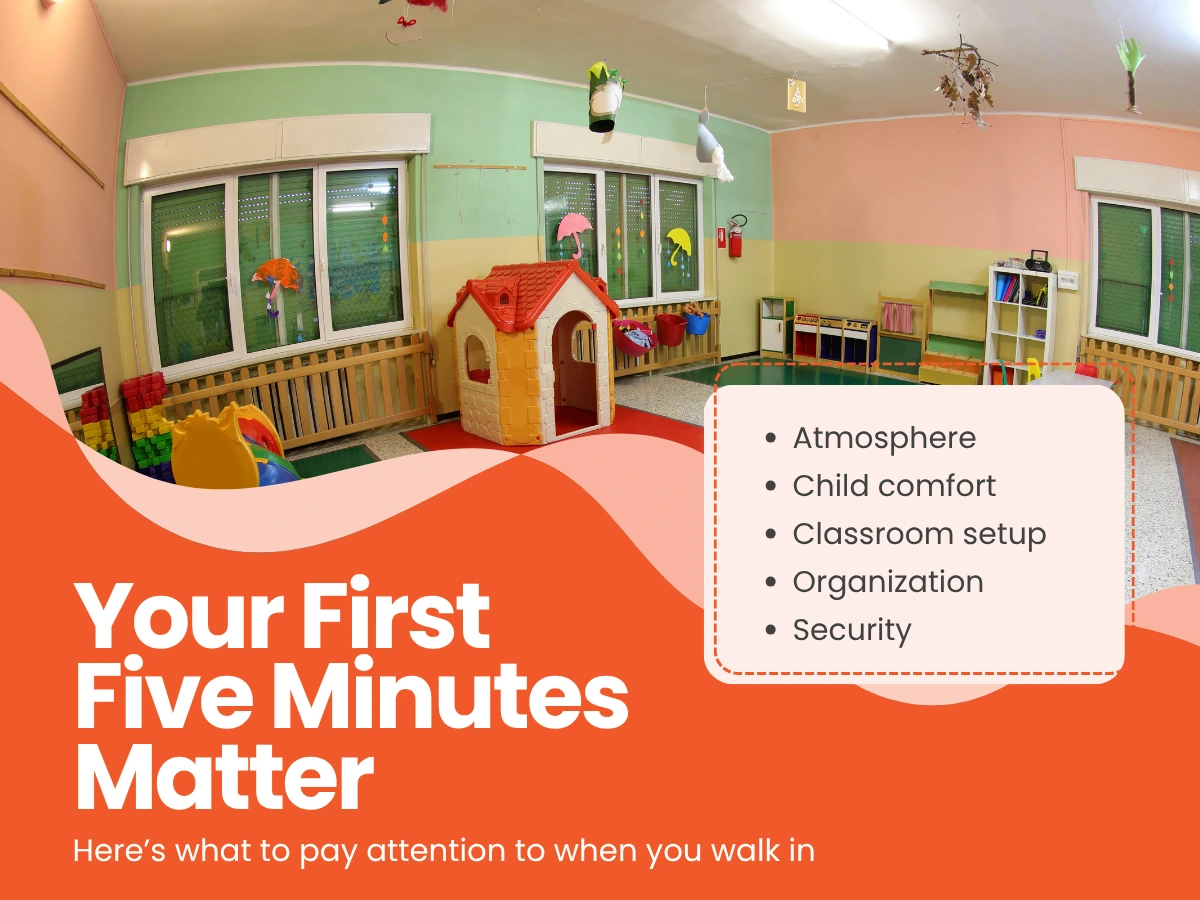
The first few minutes of a daycare tour tell you more than people realize. Before anyone explains the curriculum or hands you a folder, the center is already telling you something.
Not through marketing. Through the atmosphere.
Every center with young children is going to have noise, motion, and a bit of unpredictability. That is normal. A room full of toddlers should not feel like a library.
What you are looking for is not silence. You are looking for a place that feels busy in a good way. Warm. Managed. Lived in. The kind of environment where children are active, but the adults still seem fully in charge.
There is a difference between cheerful energy and chaos. Most parents can feel it right away.
Take a moment to observe the children.
Do they seem settled? Curious? Comfortable moving around the room? If a child is upset, how is that handled? You are not looking for a magical room where every child is smiling every second. That room does not exist. You are looking for signs that children are being guided, comforted, and responded to.
Parents sometimes get wowed by decor, but thoughtful setup matters more than matching bins.
The better question is whether the room seems designed around children’s actual day. Are materials within reach? Are there clear spaces for play, reading, movement, group time, and rest? Does the classroom feel like children belong there, or does it feel like a display adults set up?
The little things matter here.
How are you greeted? Does the front desk seem alert? Do teachers seem aware of what is happening around them, or does the room feel like people are just getting through the day?
You are not looking for perfect choreography. Real classrooms are messy. But there should still be a sense that adults are present and paying attention.
When you walk through the center, envision your child as they truly are: the one who clings at drop-off, who thrives on routine, or who struggles with transitions.
Can you picture them being genuinely understood here, not just supervised? While that feeling shouldn’t be the only factor in your decision, it certainly deserves a voice.
Once you have taken in the feel of the center, this is where the tour becomes more revealing.
A brochure can tell you what a center offers. A website can show you a nice classroom. But the questions you ask are what help you figure out how things actually work on an ordinary Tuesday.
Here are 15 preschool tour questions worth asking.
This is one of the best questions because it gets past generic “we offer a nurturing environment” language very quickly.
You want to hear how the day actually works. Meals, naps, outdoor time, learning activities, transitions, and how flexible the routine is when real kids do real-kid things.
A quality center can usually describe the day clearly without sounding like they are reciting a script.
Starting daycare can be rough, even when the center is great. Ask how they help children settle in, build trust, and handle hard drop-offs. A vague “they usually adjust” is not a very reassuring answer.
This question matters a lot. You want to hear how teachers guide behavior when children are overwhelmed, frustrated, or pushing limits. The strongest answers usually sound calm, specific, and respectful. If the answer feels defensive or strangely harsh, pay attention to that.
Once enrollment starts, this matters more than parents often expect. Ask whether updates come through an app, messages, pickup conversations, photos, or some combination.
This is practical, but it is also one of those questions that tells you how carefully the center thinks. Food routines, allergies, substitutions, and safety procedures should not sound like an afterthought.
A quality center should have a clear, concise answer to this question. If their explanation feels vague or disorganized, that in itself is telling.

Do not worry about sounding overly cautious. This is a completely normal question, and a good center should be comfortable answering it.
Ratios affect how much attention children can realistically get during the day. You are not asking for a number just to collect a number. You are asking because it shapes the pace and feel of the classroom.
This question tells you a lot. A center with steady staff and stable leadership often feels more consistent for children and less stressful for families. An average daycare may talk mostly about openings and staffing needs. A stronger one often shows signs that people want to stay.
If your child is in preschool, especially, this matters. You want to know how teachers notice growth, how they share it with families, and whether they pay attention to individual development instead of just group routines.
Some centers talk a lot about academics and barely touch this. A quality program usually understands that learning how to manage feelings, solve problems, build friendships, and handle frustration is part of the real work of early childhood.
This question saves families from so many future annoyances. Ask about registration fees, supplies, meals, enrichment, late pickup fees, and anything else that affects the actual cost.
Moving from one room to another sounds minor until it is your child struggling with it. Ask how transitions are handled and how families are kept informed.
You are not looking for a center that treats parents like a disruption. You want to know whether communication and family involvement are built into the culture or just mentioned because it sounds good.
This is a softer question, but it often gets the most natural answer. And natural answers are usually where you learn the most.
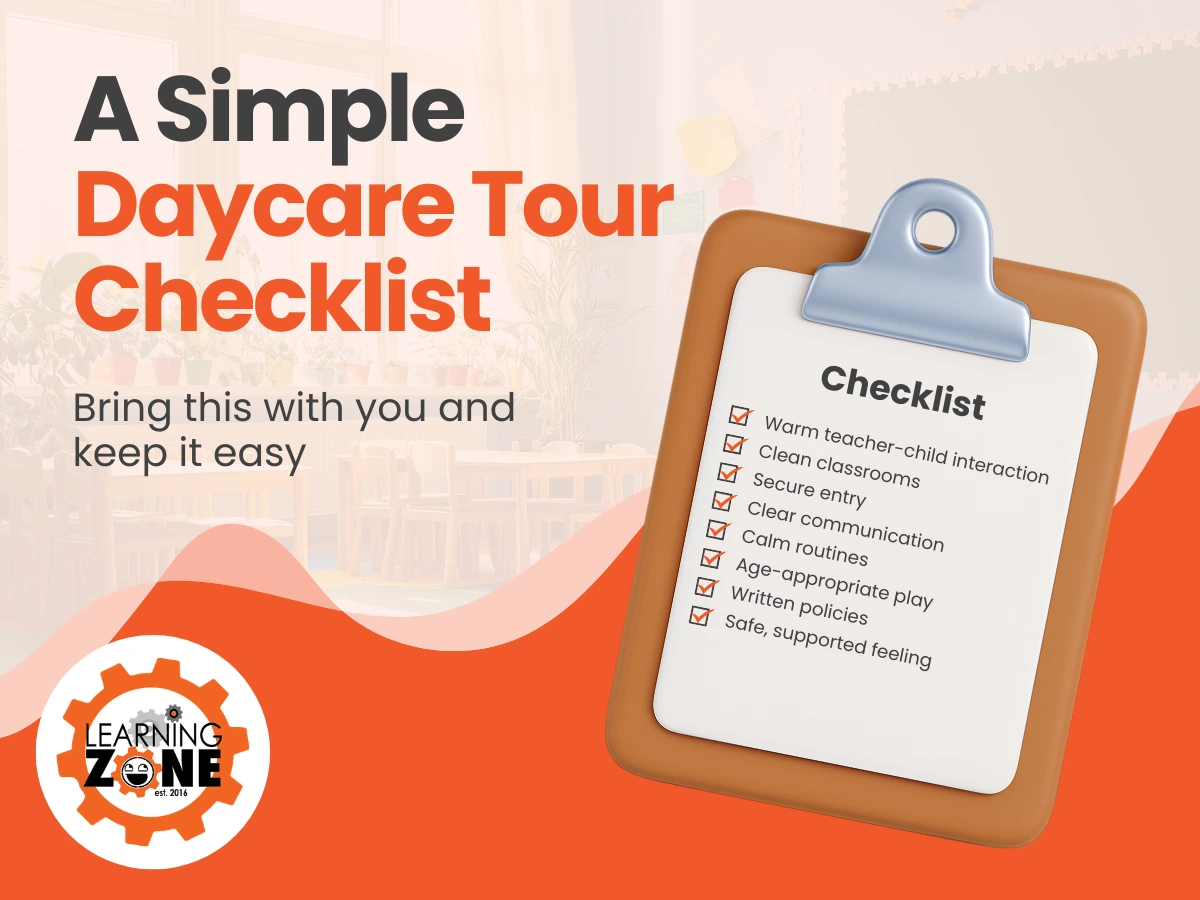
Here’s what to look for on your daycare tour:
That’s really the heart of it. It’s not about perfection or the fanciest lobby. It’s about the things that will shape your child’s day in the ways that count.
When parents tour a center, they are not just checking off boxes. They are trying to picture ordinary life there. Drop-off on a rushed Tuesday. Pickup after a long day. Whether their child will be greeted warmly. Whether the classroom will feel safe, engaging, and well run when no one is trying to impress them.
At Learning Zone, we want families to feel the same sense of relief they hope for on a tour: that this place feels warm, capable, and right for their child. Our classrooms are designed to be secure, engaging, and full of meaningful moments for children at every stage, from infant care through Pre-K. Our proprietary C3 Curriculum is built around curiosity, creativity, and comprehension, giving children hands-on STEAM learning in ways that feel natural and age-appropriate.
We also know parents are paying attention to the day-to-day details. Our Education Engineers support children through play-based learning, and features like secure entry, video monitoring, and the Procare app help families stay connected and confident throughout the day.
And because a strong early learning experience should feel like more than just getting through the day, we include programs that make childhood richer and more memorable. Our Seed-to-Table program gives children hands-on opportunities to explore gardening, sensory experiences, and healthy food connections in age-appropriate ways.
If you are getting ready to tour daycares in Middle Tennessee, we would love to welcome you in. Come see our classrooms, meet our team, and get a feel for the kind of care that helps both children and parents feel at home.